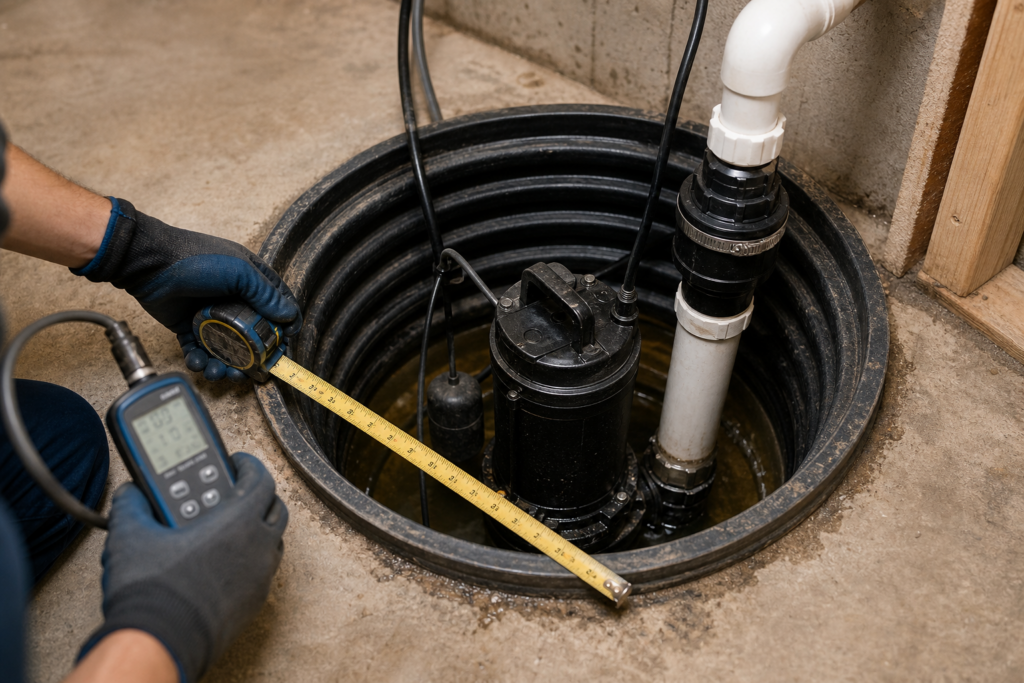
The right sump pump must remove water faster than it enters the basin during the heaviest conditions your property is likely to experience. Horsepower alone does not determine whether a pump is properly sized. Forney homeowners also need to consider groundwater inflow, vertical lift, discharge-pipe length, fittings, basin volume, and backup capacity.
A pump that is too small may run continuously while the water keeps rising. An oversized pump can empty a small basin too quickly, causing frequent starts and stops that place unnecessary wear on the motor and switch. Proper sizing balances dependable drainage with steady, efficient operation.
For a recommendation based on your property rather than a label on a box, Full Force Plumbing provides professional sump pump installation and repair in Forney.
Start With the Water Entering the Basin
The first sizing question is how much water the pump may need to handle. Two homes on the same street can have very different inflow rates because of lot grading, foundation elevation, drainage paths, soil saturation, and the location of the sump basin.
Forney’s clay-heavy soil can hold water after a strong storm. If surface grading directs runoff toward the foundation, groundwater may enter the basin faster and continue arriving longer than expected. Roof drains, nearby slopes, low areas, and poorly routed discharge water can add to the load.
A plumber can observe how quickly the water level rises during wet conditions or conduct a controlled test. Basin dimensions and the change in water level over a measured period help estimate inflow. The selected pump should exceed that expected inflow at its actual working conditions, with additional capacity for unusually heavy rain.
Sizing only for an average day can leave the system overwhelmed during the storm when it matters most.
Use the Pump’s Duty Point, Not Horsepower Alone
Homeowners often compare sump pumps by horsepower, but horsepower does not show how much water a pump will move after resistance is added. The more useful number is the pump’s flow rate, measured in gallons per minute, at a specific amount of total head.
That combination is the duty point: the amount of water the pump can deliver under the conditions created by the installation.
Every pump manufacturer provides a performance curve showing how flow decreases as the pump must push water higher or through a more restrictive discharge route. Two pumps with the same horsepower can perform differently because of their motor design, impeller, outlet size, and intended operating range.
A plumber should calculate the required capacity, determine the system’s total head, and then check the manufacturer’s performance curve. The chosen model needs to deliver enough flow at that point—not merely under the ideal, zero-resistance rating printed prominently on its packaging.
Account for Vertical Lift and the Entire Discharge Route
Vertical lift is the height from the pump outlet to the highest point of the discharge line. Greater lift requires the pump to work against more pressure, reducing its available flow.
The horizontal portion matters too. Long runs, narrow pipes, multiple elbows, check valves, and other fittings create friction. A discharge line with several sharp turns can resist flow more than a shorter, straighter route using the same pipe diameter.
The outlet also needs to release water far enough from the foundation that it does not soak the nearby soil and return to the basin. Sending discharged water back toward the house makes the pump repeat work it already completed and can overwhelm an otherwise adequate system.
A proper assessment should document:
- The vertical distance the water must rise
- The total length and diameter of the discharge pipe
- The number and type of elbows, valves, and fittings
- The condition and placement of the outdoor outlet
- Whether the line drains correctly after each cycle
- Any risk of freezing, blockage, or water returning toward the foundation
These measurements allow the installer to calculate a realistic duty point and compare it with the pump’s performance curve.
Match the Pump to the Basin
Basin volume affects how often the pump starts. If a high-capacity pump is placed in a basin that holds very little usable water between the start and stop levels, it can empty the pit in seconds and shut off. Water then rises again, causing another rapid start.
This short cycling increases wear on the float switch and motor. It may also create abrupt flow changes that stress the check valve and discharge piping.
A properly matched basin gives the pump enough water for a useful run cycle without allowing the level to approach the top. Float placement, pump height, inlet location, and the space required for reliable switch movement should all be checked.
If an existing basin is undersized, installing a more powerful pump may not solve the underlying problem. The basin, switch arrangement, or drainage entering the pit may also need attention.
Size the Backup for Real Conditions
A primary pump cannot protect the home during a power outage unless the system has a working backup. North Texas storms can bring heavy rain and electrical interruptions at the same time, so backup capacity should be part of the original sizing decision.
Battery-powered pumps often move less water than primary pumps. Their capacity must be checked at the same vertical lift and discharge resistance—not at an ideal laboratory rating. Battery condition, expected run time, charger health, alarm operation, and whether both pumps share a discharge route also affect protection.
A backup should be capable of managing likely inflow long enough to protect the property during an outage or primary-pump failure. Homes with rapid basin inflow may require a higher-capacity backup system or additional safeguards.
Regular testing remains essential after installation. Homeowners can test a sump pump before severe weather by confirming that it activates, moves water through the discharge outlet, shuts off correctly, and transfers properly to backup power.
Signs the Current Pump May Be the Wrong Size
A sump pump that runs frequently is not automatically undersized. A blocked discharge line, jammed impeller, failed check valve, poor grading, or water returning toward the foundation can produce similar symptoms.
Still, several warning signs deserve professional evaluation:
- The water rises while the pump is running
- The pump runs almost continuously during moderate rain
- The basin empties in seconds and immediately refills
- The motor starts and stops repeatedly
- Water does not appear at the discharge outlet
- The backup pump activates during normal conditions
- The system becomes unusually loud, hot, or unstable
- Moisture appears around the foundation even though the pump operates
A plumber should identify the cause before recommending a larger model. Replacing a pump without correcting a blocked or poorly routed discharge line can leave the original failure in place.
Information to Gather Before Installation
Helpful details include the basin diameter and depth, the current pump model, the discharge-pipe diameter, the approximate vertical rise, and where the line releases outdoors. Photos of the basin and discharge route can also help during the initial conversation.
Tell the plumber whether the property has experienced standing water, foundation-area moisture, frequent cycling, power outages, or previous pump failures. If possible, note how quickly the basin fills during rain.
These observations support a recommendation based on actual property conditions instead of a generic horsepower choice.
Choose a Sump Pump Built for Your Forney Property
A dependable sump pump system should handle expected inflow at the installation’s true duty point, operate correctly within the basin, move water safely away from the foundation, and provide suitable backup protection.
Full Force Plumbing can evaluate the basin, discharge route, lift, flow requirements, and backup needs before recommending equipment. To arrange a property-specific sump pump assessment, contact Full Force Plumbing.